
Why your budget stops being useful in March
Your annual budget may still be a useful target, but it can quickly become a poor guide to decisions. A driver-based forecast connects the numbers to how your business actually works, so you can adapt without rebuilding the plan.
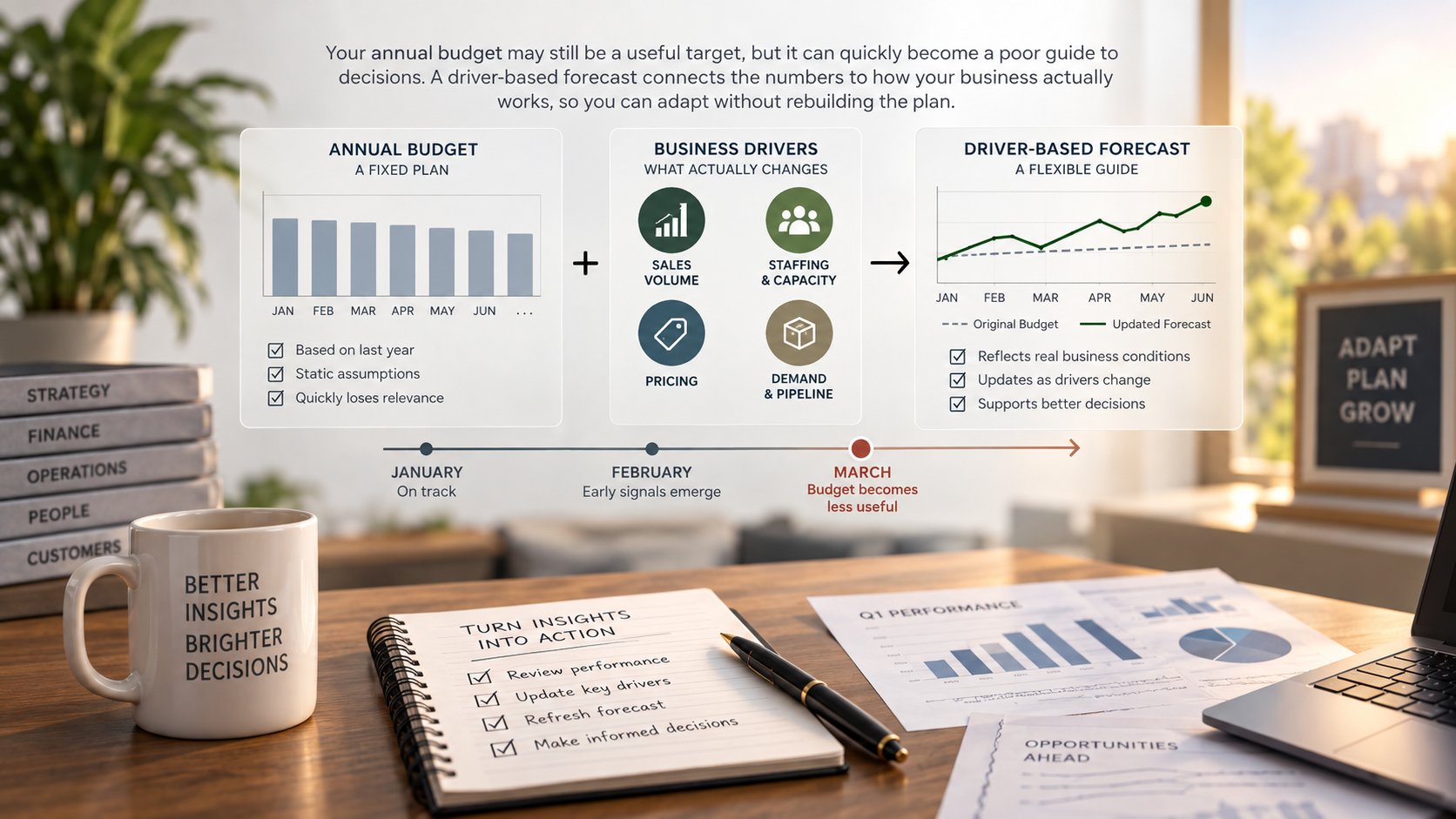
In short
- Keep the budget as your agreed target; use a forecast to show what is now likely to happen.
- Model the handful of operational drivers that materially change profit and cash, rather than updating every account individually.
- Connect changes in demand to capacity, costs and payment timing so the forecast supports real decisions.
In December, the budget looked sensible. By March, a large customer has delayed a project, recruitment has taken longer than expected and the sales mix has shifted. The spreadsheet still adds up. It just no longer describes the business you are running.
That does not necessarily mean the budget was badly prepared. It means a fixed plan is being asked to do a moving forecast’s job. A driver-based model bends with the business instead of breaking against it.
The problem is not March. It is the assumptions underneath.
Many budgets are built by taking last year’s figures, adding growth and spreading the result across twelve months. Managers negotiate their lines, the board approves the total and the numbers become the benchmark. This can help establish spending limits and financial ambitions. It is less useful for explaining what happens when trading changes.
A revenue target does not tell you how many enquiries must convert, how quickly orders can be delivered or whether you have enough people to fulfil them. A payroll total does not explain the impact of a delayed hire. And a monthly profit figure does not tell you when customers will pay.
When those relationships are missing, every change requires another manual adjustment. The spreadsheet becomes a collection of revised guesses rather than a coherent view of the business.
Do not replace the target every time reality moves
Once the budget loses relevance, there is a temptation either to ignore it or continually rewrite it. Neither is ideal. Ignoring it weakens accountability; rewriting it can erase the gap between the original ambition and actual performance.
Keep the approved budget visible, but maintain a separate current forecast. Add scenarios where a specific uncertainty matters. Each view answers a different management question.
| View | Question it answers | How to use it |
|---|---|---|
| Budget | What did we agree to achieve? | Track performance against the original targets and spending commitments. |
| Current forecast | What is most likely now? | Update expectations using actual results and revised operating assumptions. |
| Scenario | What happens if something changes? | Test decisions or risks, such as a delayed contract or an additional hire. |
This distinction also improves conversations. A weaker forecast is not automatically an excuse for missing the budget. It is information that allows you to act before the shortfall becomes unavoidable.
Model how the business earns and spends money
A driver-based model calculates financial outcomes from operational assumptions. For a consultancy, revenue might depend on available delivery days, billable utilisation and realised day rate. For a product business, it might depend on units sold, net selling price and returns. For a subscription business, opening customers, new additions, cancellations and average revenue per customer may be the starting point.
The right drivers are specific to your business. Choose inputs that materially affect the result, can be estimated with reasonable confidence and have someone responsible for maintaining them. More detail is not automatically better: separating every minor expense can create work without improving a decision.
Start with the main revenue stream, its direct costs, staffing and the timing of cash receipts and payments. Keep genuinely fixed costs simple. Model larger costs according to their behaviour: some vary with volume, while others increase in steps when capacity is reached.
Above all, connect the assumptions. Higher sales may require more stock, additional delivery staff or overtime. If revenue grows but the resources needed to deliver it remain unchanged, the model may be forecasting a business that cannot operate.
A delayed hire should change more than payroll
Consider an illustrative service business with ten fee-earning staff. Each has 20 available delivery days in a month, expected billable utilisation is 70% and the realised day rate is £800. Those assumptions imply monthly revenue of £112,000: ten people multiplied by 20 days, 70% and £800.
If one role remains vacant, the same assumptions imply £100,800. Payroll may be lower, but so is delivery capacity. A static budget might show the salary saving as favourable while leaving the revenue target untouched. A connected model reveals the trade-off.
Management can then test options: use a contractor, move delivery dates or prioritise higher-margin work. Each option should change the relevant assumptions and costs, not simply overwrite the revenue total.
The model also needs a demand constraint. Available capacity is not the same as sold work. If confirmed work and credible pipeline cannot fill those billable days, adding staff will not create the forecast revenue. Finally, cash should follow expected invoicing and collection timing, rather than arriving automatically when revenue is recognised.
Build a monthly decision rhythm, not another reporting burden
Begin with the next decision the forecast must support. Can you afford two hires? Will a new contract create a cash squeeze? Does slower demand require a change in purchasing? That question determines the detail and time horizon you need.
Each month, replace completed periods with actual results and refresh the remaining assumptions with their operational owners. Sales should explain changes in demand; operations should explain delivery capacity; finance should check the financial relationships and cash timing. Keep enough forward visibility to cover significant commitments and seasonal pressure points.
Review what changed from the previous forecast, not just the variance against budget. Separate timing movements from lasting changes. A project pushed back a month calls for a different response from a customer that has cancelled altogether.
End the review with decisions, owners and triggers. You might agree to defer recruitment until contracted workload reaches a defined level, or revisit purchasing if stock moves more slowly than expected. The forecast becomes useful when it changes what you do.
You do not need to abandon the annual budget. You need to stop expecting it to remain an accurate map after the route has changed.

About the author
Azadeh Aghajani, FCA
Founder of Simora Advisory. Twenty years in senior finance — CFO of two private-equity-backed payments companies, CFO of Asset Servicing at BNY, and FP&A and pricing leadership at TSYS, Barclays and RBS. She qualified as a Chartered Accountant at PwC.