
The thirteen-week cash view every owner should keep
The one report that answers "can we afford this" without a call to the accountant — and the half-day it takes to build.
In short
- Profit and cash are different questions. A thirteen-week view answers the second one.
- Forecast receipts on the date customers actually pay, not the date you invoice.
- Update it weekly. A rough model revised often beats a precise one revised never.
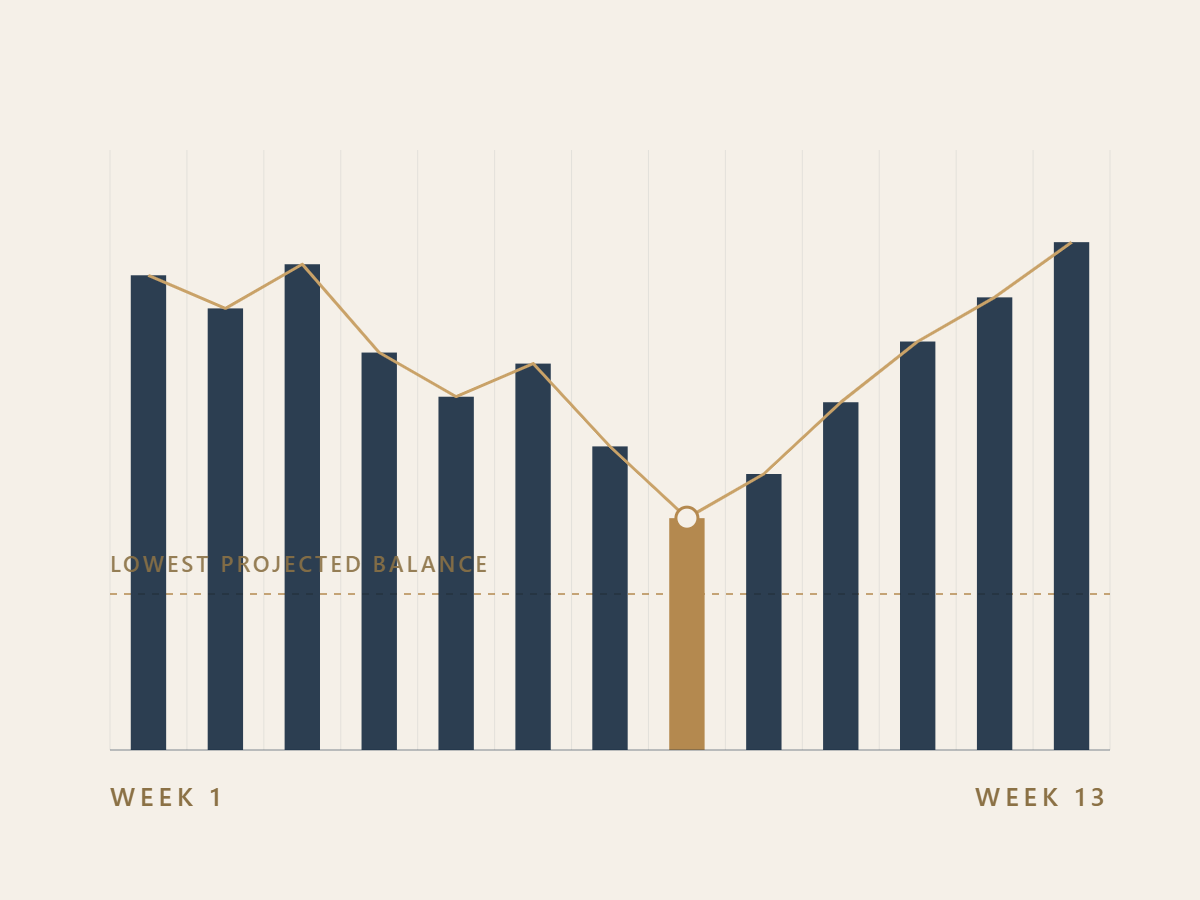
- The number that matters is the lowest projected balance, not the closing one.
Most owner-led businesses do not fail because the work dried up. They fail because a profitable month and a solvent month are not the same thing, and nobody was watching the gap. Profit is an opinion formed at the end of a period. Cash is a fact that arrives on a Tuesday, or does not.
The thirteen-week cash flow is the standard tool for closing that gap. It is not a forecast in the budgeting sense — it does not try to be right about the year. It answers one question, every week: what will be in the bank on any given Friday between now and the end of the quarter?
Why thirteen weeks
Thirteen weeks is one quarter. It is long enough that a problem appears while you can still do something about it — renegotiate a term, chase a receivable, delay a hire — and short enough that the numbers are real rather than assumed. Beyond about a quarter you are modelling the business; inside it you are managing it.
Building it: five rows and a habit
The model itself is simple enough to hold in one spreadsheet tab. The discipline of updating it is the hard part.
- 01
Start with the bank, not the ledger
Opening balance is today’s actual cleared balance across every account. Not the accounting system’s cash figure — the bank’s.
- 02
Lay out receipts by expected pay date
Take the open receivables ledger and place each invoice in the week you realistically expect the money, based on that customer’s history.
- 03
Separate committed from discretionary spend
Payroll, rent, debt service and tax are fixed dates. Everything else is a choice — and choices are what you adjust when a week looks tight.
- 04
Add the irregulars nobody remembers
Quarterly insurance, annual software renewals, bonus months, VAT or estimated tax payments. These cause most of the surprises.
- 05
Review it every Monday, without exception
Compare last week’s forecast to what happened, correct the assumptions, and roll the window forward one week.
What good looks like
Four measures tell you most of what you need to know about the cash position. Track them weekly alongside the forecast.
| MEASURE | HEALTHY | WHAT IT TELLS YOU |
|---|---|---|
| Cash runway | 13+ weeks | Weeks of operating cost covered by cash on hand plus expected receipts. |
| Days sales outstanding | Within terms +10 | How long customers really take to pay against what you agreed. |
| Forecast accuracy | Within 10% | Last week’s projected closing balance against the actual. Drift means bad assumptions. |
| Lowest projected balance | Above your floor | The worst week in the window — the number that actually constrains decisions. |
13
Weeks in the window20 min
Weekly upkeep once built1 tab
All it needs to live in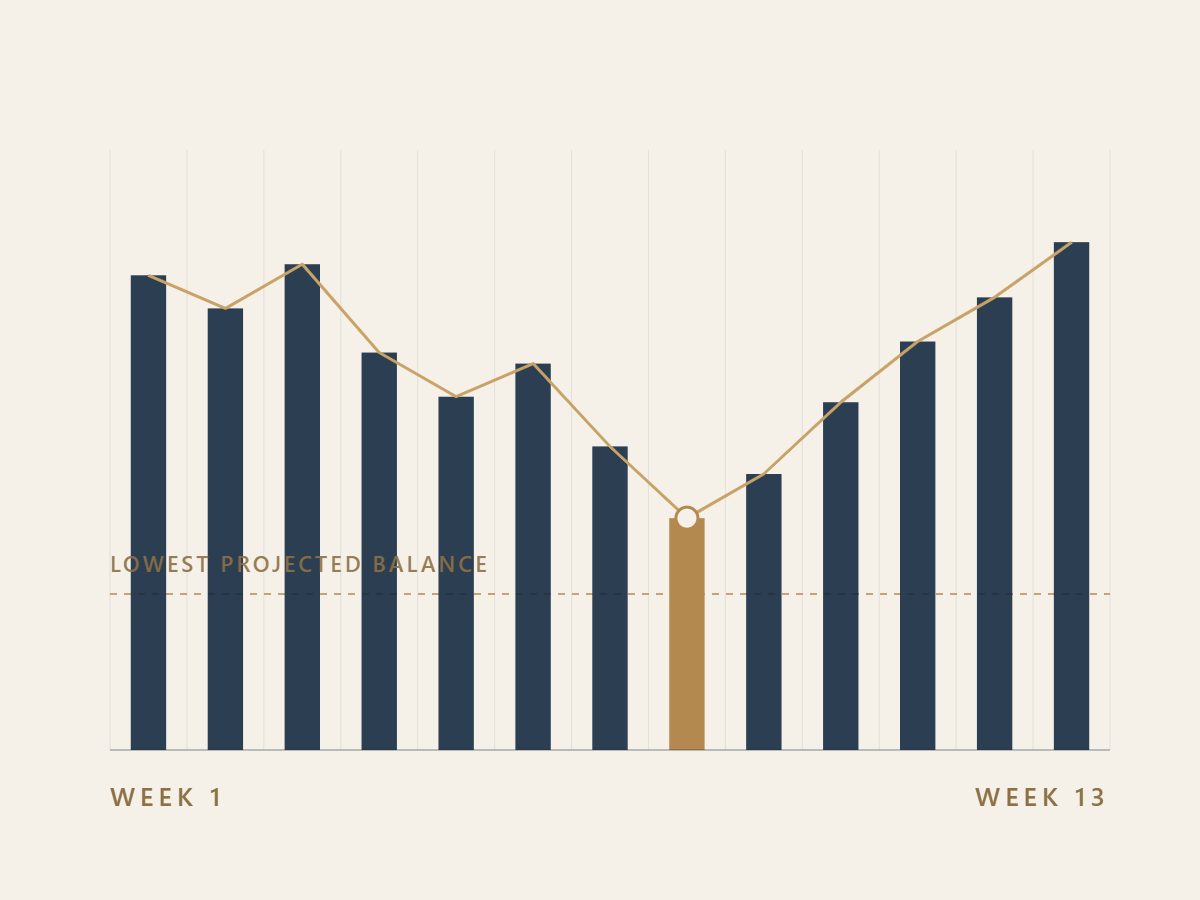
Every owner I have worked with who got surprised by cash had the information somewhere. It just was not on one page, in front of them, on a Monday.
Your Monday checklist
Twenty minutes, same time each week. Tick them off as you go.
0 of 5 complete

About the author
Azadeh Aghajani, FCA
Founder of Simora Advisory. Twenty years in senior finance — CFO of two private-equity-backed payments companies, CFO of Asset Servicing at BNY, and FP&A and pricing leadership at TSYS, Barclays and RBS. She qualified as a Chartered Accountant at PwC.